

Mobile internet speeds have improved across most major ASEAN destinations, with Metro Manila recording a median download speed of 75.57 Mbps in Q2 2026, according to Ookla’s latest Speedtest Intelligence data.

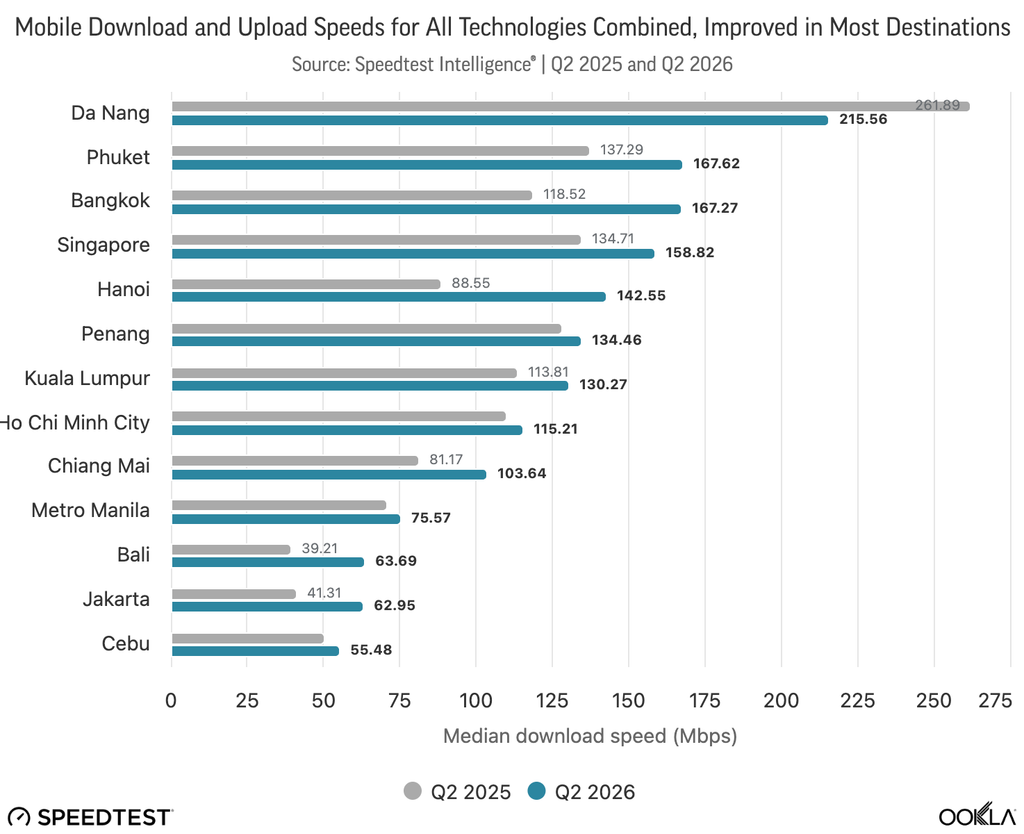
The data, which compares Q2 2025 and Q2 2026 performance across 13 destinations, shows that mobile download speeds increased in 12 of 13 locations, while 5G Availability also expanded across every destination.
Why it matters: For remote workers and digital nomads, mobile connectivity remains relatively strong across the region. However, improvements in 5G Availability have not always translated to more consistent high-speed connections.
The details: Da Nang, Vietnam recorded the fastest median mobile download speed at 215.56 Mbps, followed by Phuket at 167.62 Mbps and Bangkok at 167.27 Mbps.
Singapore posted 158.82 Mbps, while Hanoi reached 142.55 Mbps and Penang recorded 134.46 Mbps. Kuala Lumpur and Ho Chi Minh City followed with 130.27 Mbps and 115.21 Mbps, respectively.
Metro Manila ranked 10th among the 13 destinations at 75.57 Mbps, ahead of Bali at 63.69 Mbps, Jakarta at 62.95 Mbps, and Cebu at 55.48 Mbps.
5G Availability expands: 5G Availability increased across all 13 destinations, ranging from 83.8% in Phuket to 40.0% in Penang.
Despite the wider 5G reach, the proportion of 5G samples meeting the benchmark of 25 Mbps download and 3 Mbps upload declined in seven destinations compared with the previous year.
Connection stability remains a concern: Mobile jitter increased in 11 of the 13 destinations, although none crossed the 30ms threshold that Microsoft Teams classifies as poor.
Da Nang recorded the lowest jitter at 7ms, while Cebu had the highest at 18ms. This means mobile connections across the destinations remained within a range suitable for video calls despite the year-over-year increase in jitter.
Fixed broadband shows a wider gap: The differences between destinations become more pronounced when looking at fixed broadband.
Singapore recorded the highest median fixed download speed at 447.75 Mbps, while Jakarta came in at 60.33 Mbps.
Chiang Mai, meanwhile, posted a median fixed download speed of 258.50 Mbps, but only 65.7% of its fixed samples met the 25 Mbps download and 3 Mbps upload benchmark, highlighting that median speeds alone do not tell the full story about connection reliability.
Wi-Fi remains the final link: The Wi-Fi connection used by a remote worker can also determine how much of a venue’s fixed broadband performance actually reaches their device.
Singapore led the region in Wi-Fi 7 adoption, with 34.4% of reported Wi-Fi connections using Wi-Fi 7. This was seven and a half times higher than the next ASEAN destination.
Meanwhile, older Wi-Fi standards remain common in some locations, with Wi-Fi 4 accounting for 42.7% of connections in Jakarta and 41.9% in Bali.
The bigger picture: The results show that ASEAN’s major digital nomad hubs continue to offer generally satisfactory mobile connectivity, with median download speeds ranging from 55.48 Mbps in Cebu to 215.56 Mbps in Da Nang.
However, the expansion of 5G does not necessarily mean more consistent high-speed performance. Fixed broadband and Wi-Fi infrastructure also remain important factors for remote workers who depend on reliable connections for extended work sessions.
For Filipinos: Metro Manila’s 75.57 Mbps median mobile download speed places it ahead of Bali, Jakarta, and Cebu, but behind the other major destinations included in the comparison. Cebu recorded the lowest median mobile download speed among the 13 destinations at 55.48 Mbps, while also registering the highest mobile jitter at 18ms.
What’s next: As 5G Availability continues to expand across ASEAN, the quality and consistency of those connections will remain important for the region’s growing digital nomad and remote-work market.
Get the latest from WALASTECH directly on your Google feed.
Add as a preferred source on Google