

TRANSSION remained the Philippines’ leading smartphone vendor in the second quarter of 2026, accounting for 33% of smartphone shipments, according to Omdia. Xiaomi followed with 22%, while Samsung ranked third at 16%. HONOR and OPPO completed the local Top Five with 10% each.
Why it matters: The Philippine rankings show a market still dominated by brands with strong affordable and mid-range portfolios, even as rising device prices weigh on smartphone shipments across Southeast Asia.
The details: Omdia’s 2Q26 data puts TRANSSION at the top of the Philippine smartphone market with a 33% share. Its portfolio includes TECNO, Infinix, and itel.
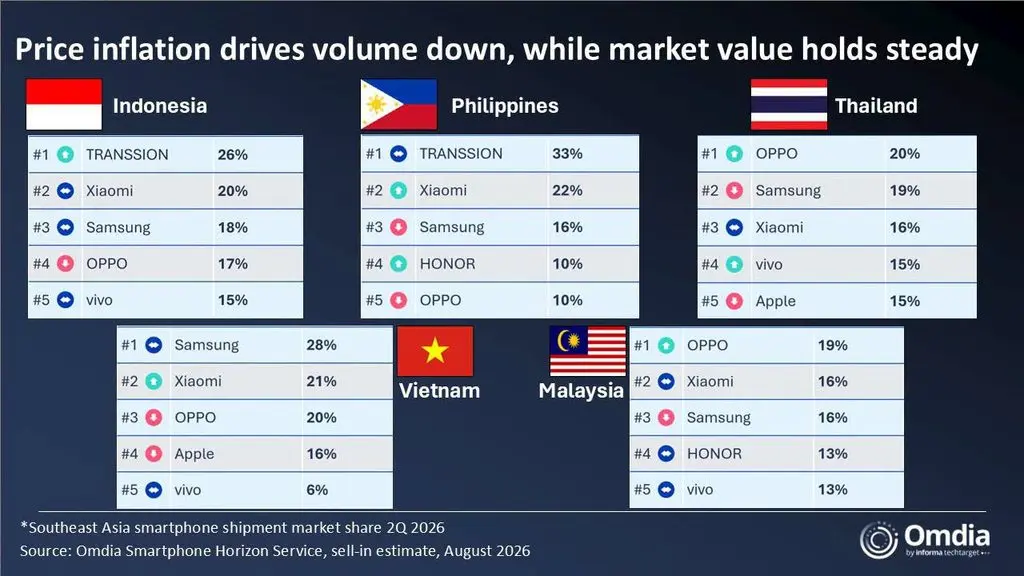
Xiaomi took second place with 22%, a significant jump that puts it within 11 percentage points of TRANSSION.
Samsung ranked third with 16%, while HONOR and OPPO each captured 10%.
| Rank | Brand | 2Q26 market share |
|---|---|---|
| #1 | TRANSSION | 33% |
| #2 | Xiaomi | 22% |
| #3 | Samsung | 16% |
| #4 | HONOR | 10% |
| #5 | OPPO | 10% |
A quick fact-check on HONOR’s ranking: Some local reports describing Omdia’s 2Q26 figures have characterized HONOR’s appearance in the Top Five as a first for the brand in the Philippines. That is not accurate.
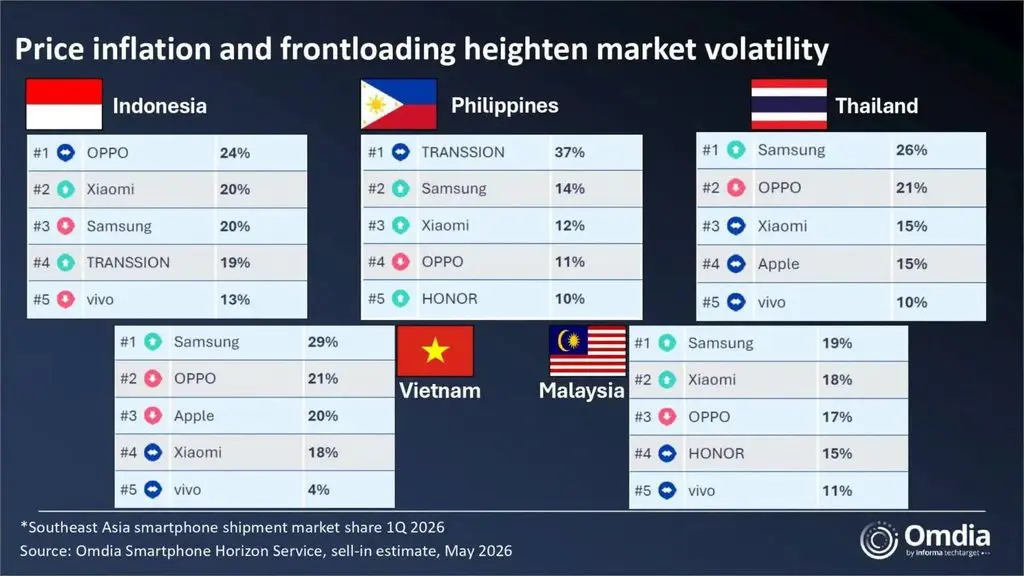
Omdia’s 1Q26 data already placed HONOR in fifth place in the Philippines with a 10% market share. The 2Q26 figures therefore show HONOR moving up one position to fourth while maintaining the same 10% share—not entering the Top Five for the first time.
This distinction is worth keeping in mind when reporting quarterly rankings, particularly when describing a brand’s historical market position.
The bigger picture: The Philippine market is being measured against a much weaker regional backdrop.
Southeast Asian smartphone shipments fell 23% year-on-year in 2Q26 to 19.3 million units, the lowest quarterly level since 2014. At the same time, the region’s smartphone market value remained relatively resilient at $6.6 billion as average selling prices rose 31% to $342.
Omdia said the Philippines, along with Indonesia, is expected to experience a larger decline because of its greater exposure to entry-level devices and open-market retail channels.
The shift is particularly visible at the lower end of the market. The share of smartphones priced between $100 and $199 increased from 32% of regional shipments in 2Q25 to 39% in 2Q26, while overall shipments of devices priced above $100 still declined 2%.
That suggests the market is not simply moving consumers toward more expensive phones. Some buyers are delaying or skipping upgrades altogether.
Between the lines: The Philippine ranking also shows how differently brands are responding to the changing market.
TRANSSION continues to benefit from its broad affordable portfolio, although its regional shipments declined 25% year-on-year.
Xiaomi’s regional shipments declined 21%, but its average selling price increased 43.5%. Its sub-$100 shipments fell 69%, while shipments in the $100–199 range increased 55%.
OPPO experienced the steepest shipment decline among Southeast Asia’s five largest vendors, falling 41%. Its sub-$100 shipments dropped 96%, while vivo’s shipments in the same price segment fell 88%.
The changes point to a broader industry strategy: vendors are increasingly protecting prices and margins rather than chasing shipment volume at the lowest end of the market.
For Filipinos: The local rankings underline how important affordable smartphones remain in the Philippines.
TRANSSION’s 33% share gives it an 11-point lead over Xiaomi, while the combined 55% share of the two companies means more than half of Philippine smartphone shipments in 2Q26 came from these two vendors.
Samsung remains a strong third at 16%, while HONOR’s continued presence in the Top Five gives the brand another quarter of established market presence rather than a first-time breakthrough.
The bigger concern for Filipino buyers may be what happens to prices next. Omdia expects the Southeast Asian market to contract 25% for the full year to 75.3 million units, with higher device prices continuing to pressure demand.
What’s next: Rising memory costs could add further pressure in the second half of 2026. Omdia said devices shipped during the first half still benefited from memory purchased at earlier, lower prices. As that inventory is depleted, manufacturers will face the impact of higher current memory costs.
For the Philippine market, the next quarters will show whether Xiaomi can sustain its rapid growth, whether TRANSSION can defend its lead, and whether HONOR can build on its established Top Five position.
The Bottom Line: TRANSSION continues to lead the Philippine smartphone market, with Xiaomi making a significant jump to second place and Samsung holding third. HONOR is now fourth alongside OPPO at 10%.
HONOR’s rise is worth noting, but the correct takeaway from the latest data is that the brand maintained its Top Five position and moved up to fourth—not entered the Top Five for the first time.
Get the latest from WALASTECH directly on your Google feed.
Add as a preferred source on Google